
Secondaries in Private Investment Portfolios: A Framework for Strategic Allocation


The secondary market has evolved from its origins as a niche solution for liquidity-constrained investors into a cornerstone of private investments (PI). Institutional adoption, innovation in transaction structures, and the expansion of private market assets have increased both its scale and its strategic relevance. Secondaries have provided institutional investors with more than liquidity: they have supported portfolio construction, risk management, capital redeployment, and long-term value creation.
The benefits of an early allocation to secondaries are well established, but their usefulness extends beyond the initial build-out of a PI program. As portfolios mature, secondaries have provided attractive risk-adjusted returns and dynamic tools for proactive portfolio management. Informed by decades of performance data and our own simulated portfolio analysis—which demonstrates that a consistent allocation to secondaries has generated higher distributions and terminal portfolio value relative to strategies that reduce or forgo secondaries exposure over time—institutional investors should consider maintaining a minimum allocation of 10% of their PI commitments to secondaries on an ongoing basis. Secondaries should be treated not as a tactical allocation but as a potentially permanent component of a modern PI portfolio.
Introduction to secondaries
What are secondaries?
Secondaries are transactions involving the purchase and sale of existing investor commitments to private market assets, allowing investors to transfer their interests before a fund’s natural conclusion. The market provides liquidity, flexibility, and portfolio management opportunities for both buyers and sellers.
The market spans several transaction types. These include limited partner (LP) sales, in which original LPs sell fund interests to new investors; GP-led liquidity offerings, in which general partners (GPs) restructure existing funds or extend ownership of selected assets through innovative mechanisms such as continuation vehicles (CVs); direct secondaries, which involve the acquisition of interests in individual companies or portfolios of companies outside traditional fund structures; and structured solutions, which offer tailored approaches to address complex portfolio objectives.
Historical context & market momentum
Secondary transactions were initially viewed as a last-resort liquidity solution for distressed or liquidity-constrained investors, often associated with forced sales and underperformance. This stigma extended to both selling LPs and underlying GPs, and for years many institutions avoided secondary sales. The market was also small and fragmented: the first dedicated secondary funds emerged in the 1990s, global transaction volume first exceeded $1.0 billion in 1998, and annual volume did not reach $10 billion until 2006 (Figure 1).
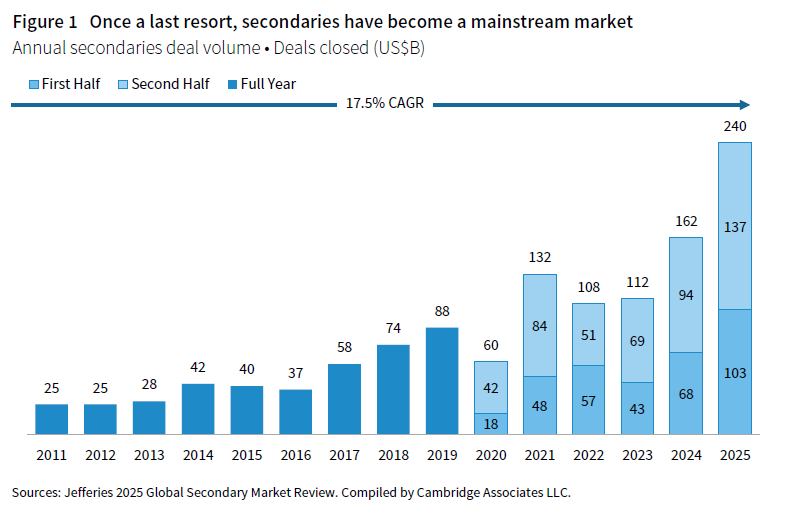
Over the past two decades, however, the secondary market has changed significantly. Annual transaction volume reached $240 billion in 2025, surpassing $200 billion for the first time. As LPs have broadened their use of secondary sales for portfolio management and liquidity, the market has become more dynamic and mainstream. At the same time, the steady increase in private market assets under management (AUM) has expanded the supply of potential transactions.
The rise of GP-led secondaries—including continuation vehicles and fund restructurings—has introduced new sources of liquidity, deal flow, and innovation. Meanwhile, increasing recognition by institutional investors of the strategic benefits of secondaries, coupled with the proliferation of intermediaries, has driven substantial growth in fundraising and market participation. This heightened demand has led to a growing universe of buyers, the formation of larger secondary funds, and the introduction of evergreen capital, further enhancing market capacity and supporting long-term growth.
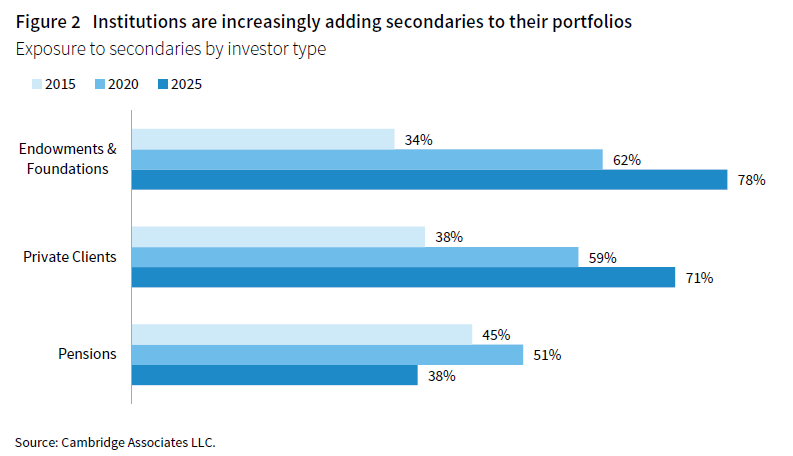
In tandem with this evolution, institutions of all types and sizes are increasingly adding exposure to secondaries within their PI portfolios. As of December 31, 2015, approximately 34% of endowments and foundations had exposure to secondaries; by December 31, 2025, that figure had risen to 78%. Among private investors, the share rose from 38% to 71% over the same period. However, pension funds saw a more modest reduction from 45% to 38%, likely reflecting the more prescriptive investment guidelines and liability-driven frameworks that govern many pension programs (Figure 2).
The secondary market’s transformation has not only expanded the scale and sophistication of its participants but also enhanced its role in portfolio management. With this context in mind, the following section explores how secondaries can deliver value—both in the early stages of a PI program and as a lasting source of portfolio optimization.
Secondaries: A permanent pillar of portfolio management
Early benefits
For investors launching a PI program, an early allocation to secondaries can accelerate cash flows, mitigate the impact of the J-curve, and provide immediate diversification. Together, these features can help smooth returns and reduce early concentration risk.
Accelerated cash flow & J-curve mitigation
Unlike primary fund commitments, which are blind-pool investments, secondaries provide LPs with exposure to established assets and the related benefits of a more immediate performance profile. Secondary funds often feature a faster return of capital, as buyers largely acquire interests in funds that are partially or fully invested, allowing LPs to receive earlier distributions rather than waiting through the initial investment period. By entering at a later stage in the fund’s life cycle, LPs can avoid much of the early negative return profile known as the J-curve.
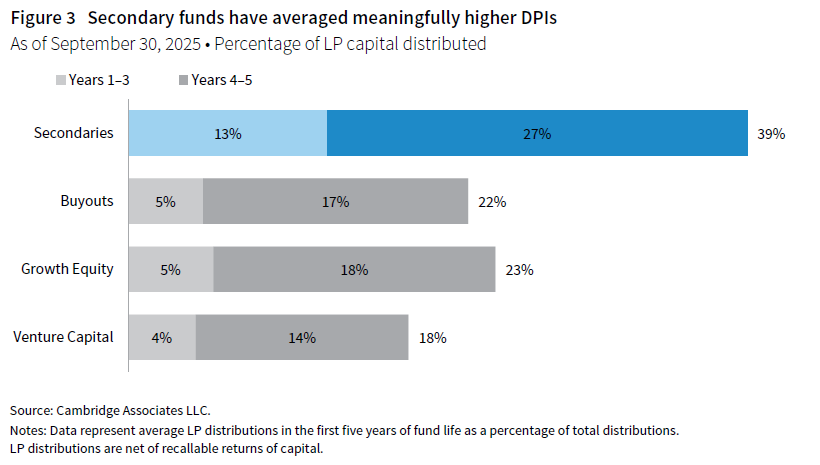
Secondary funds have averaged 13% distribution to paid-in capital (DPI) in the first three years of a fund’s term and nearly 40% DPI in the first five years, meaningfully higher than direct buyout, growth, and venture funds (Figure 3).
Discounts & “instant” diversification
Secondary buyers often seek to acquire assets at a discount to net asset value (NAV), which can provide a margin of safety and improve the potential for attractive risk-adjusted outcomes as the underlying investments mature and are realized at or above NAV. By aggregating assets acquired from a range of existing portfolios, secondary funds deliver immediate diversification across vintage years, asset classes, geographies, and GPs. These benefits are particularly relevant in the early stages of a PI program, but they do not disappear once the portfolio matures.
Enduring benefits
As a PI portfolio grows and matures, the demands of portfolio construction and management can become increasingly nuanced, requiring ongoing flexibility. Investors must manage liquidity, capital deployment, concentration, and performance through changing market conditions. Secondaries can continue to support these objectives well beyond the early years of a program.
Consistent returns & resilience amid volatility
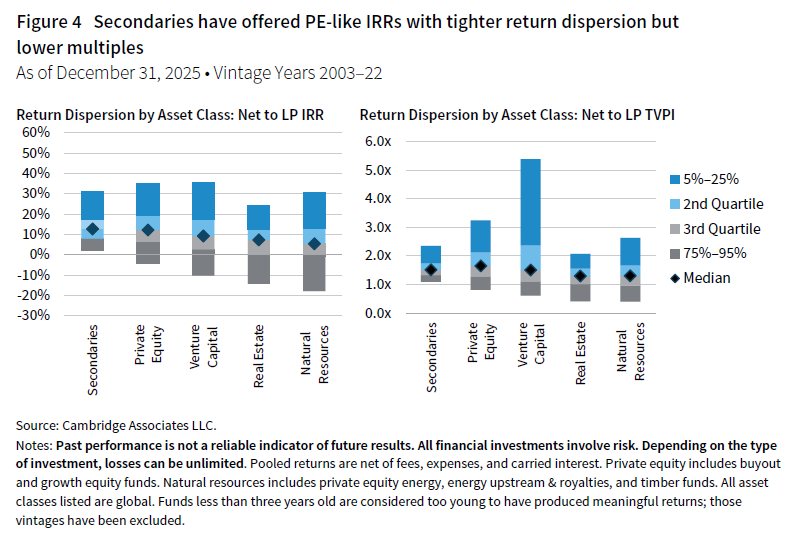
A defining feature of secondary funds is their ability to deliver competitive, risk-adjusted returns across a range of market environments. Secondary funds have delivered median internal rates of return (IRRs) broadly comparable to private equity (PE), while exhibiting significantly tighter return dispersion and more limited downside risk (Figure 4). On a TVPI basis, however, secondaries characteristically offer a lower and narrower range of outcomes than PE or venture capital—reflecting the more mature, de-risked nature of the underlying assets. For investors prioritizing consistency and capital preservation over maximum upside, this trade-off is a feature rather than a limitation—secondaries are designed to compound capital reliably, not to swing for outsized multiples.
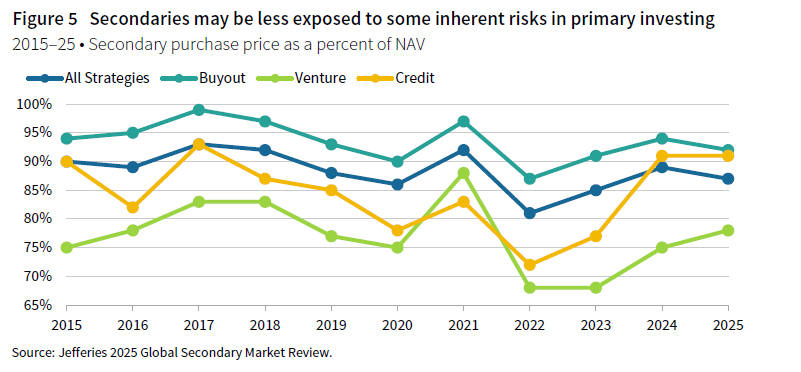
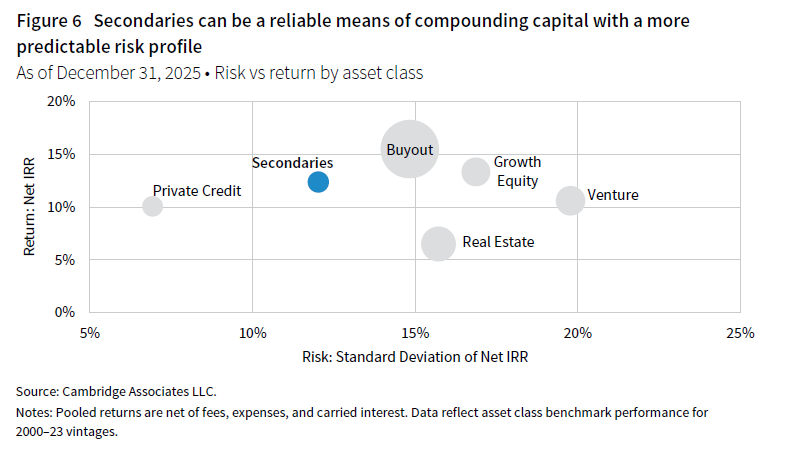
By focusing on portfolios with greater transparency, less blind-pool risk, and entry prices that may be below NAV (Figure 5), secondaries may be less exposed to some of the risks inherent in primary investing. While discounted pricing can support returns, it is only one driver alongside underlying asset quality, portfolio maturity, and the pricing discipline of experienced secondary managers—who may also be positioned to capitalize on dislocations or stale valuations driven by reporting lags. We believe risk-return dynamic positions secondaries as a reliable means of compounding capital with a more predictable risk profile (Figure 6).
Notably, recent transaction activity has been driven more by seller liquidity needs and portfolio management objectives than by the broad distressed selling seen during the Global Financial Crisis. Taken together, these characteristics may offer investors a reliable means of compounding capital and support the case for maintaining a consistent allocation to experienced secondary managers across market environments.
Efficient capital redeployment
Secondaries can also facilitate efficient capital redeployment for LPs as portfolios evolve. Because secondary funds acquire seasoned assets that are often closer to realization, distributions may be returned more quickly than with primary commitments—giving LPs the flexibility to recycle that capital into new PI opportunities, meet capital calls, and maintain target allocations without requiring additional capital infusions.
Figure 7 presents a secondaries allocation scenario analysis comparing three hypothetical PI portfolios over a ten-year period, each assuming annual commitments of $10 million with full reinvestment of all distributions. Portfolio A maintains a consistent allocation to secondaries throughout the period; Portfolio B includes an early allocation to secondaries but phases it out over time in favor of primary funds; and Portfolio C allocates exclusively to primary funds.
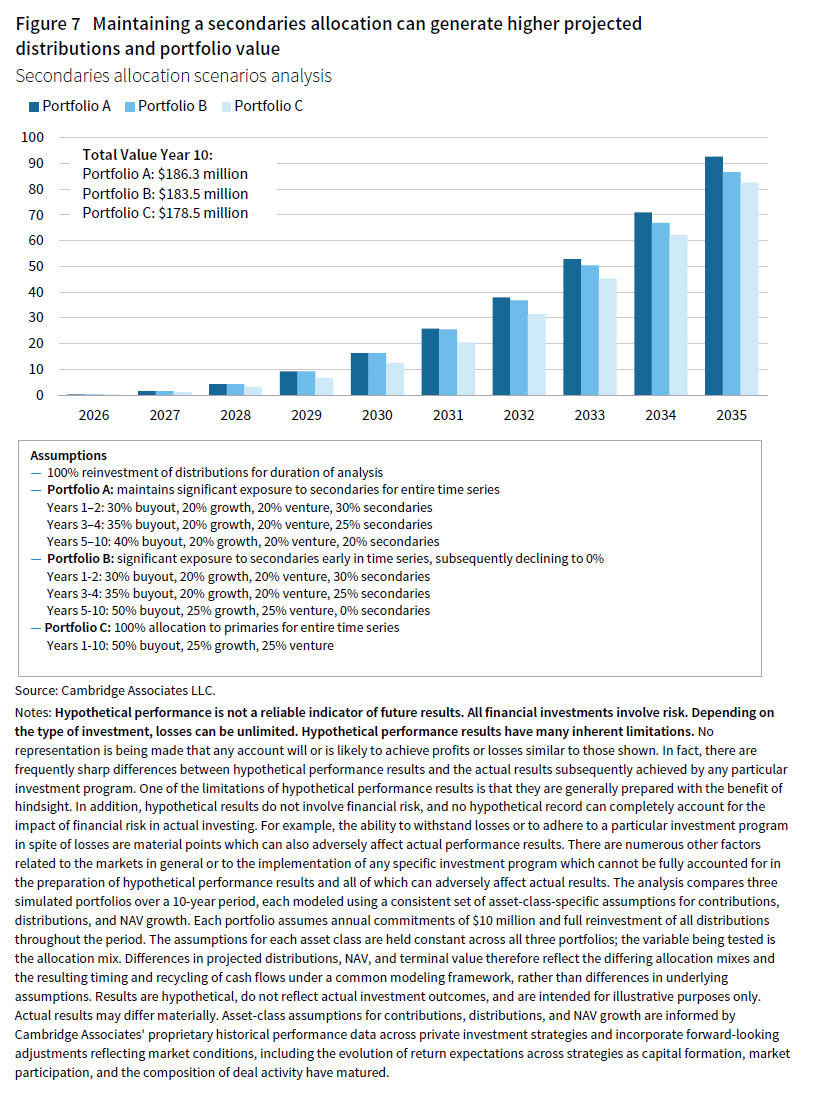
The results are instructive. Portfolio A’s projected distributions exceed those of Portfolio B by nearly 7% and those of Portfolio C by more than 12%.—incremental capital that can be redeployed into whatever strategies are most attractive at the time, enhancing both liquidity and portfolio optionality. This distribution advantage is most evident in the early years, when accelerated distributions help mitigate the J-curve and provide capital for reinvestment. While the compounding effect of reinvested distributions also results in a higher projected terminal portfolio value for Portfolio A by year ten, the more immediate and durable benefit is the enhanced liquidity and capital availability that a consistent secondaries allocation provides throughout the life of the program. These results support treating secondaries as a permanent component of a PI portfolio rather than a tactical or transitional allocation.
GP-led secondaries: Offense and defense for the modern PI portfolio
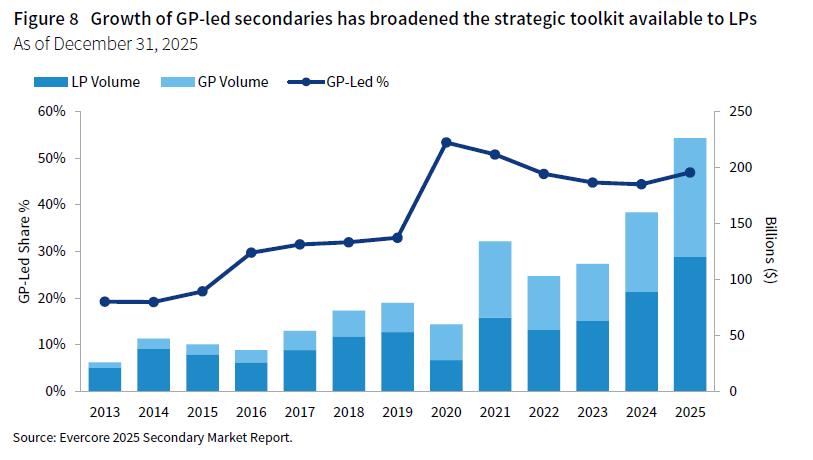
The growth of GP-led secondaries—which have represented an increasing share of market volume this decade and between 13% and 15% of annual sponsor-backed exit value from 2022 to 2025—has broadened the strategic toolkit available to LPs (Figure 8). These structures, especially continuation vehicles, allow investors to tailor exposures in response to changing market conditions and specific investment objectives.
By electing to roll into a continuation vehicle, LPs can maintain or increase exposure to high-quality, mature assets and potentially capture further upside with more asset-level underwriting visibility. Early data suggest that single-asset continuation vehicles can perform broadly in line with buyout funds, with tighter dispersion of returns. At the same time, the available performance dataset remains nascent and realized distributions for more recent vintages are limited. As the market continues to mature and more transactions season through their full lifecycle, a clearer and more comprehensive performance picture is expected to emerge.
Alternatively, choosing to “sell” provides immediate liquidity and the opportunity to redeploy capital. This dual capability—playing offense by pursuing upside, or defense by managing risk and rebalancing—underscores the strategic flexibility that GP-led secondaries bring to modern portfolio management.
These decisions are rarely straightforward and as such, LPs must carefully evaluate the terms of the continuation vehicle—including carried interest structures, management fees, and governance rights—to ensure alignment of interests and assess whether the transaction represents fair value. Compounding this complexity, LPs are also often required to make these decisions within a limited timeframe, typically 20–30 business days, with significant implications for their portfolio. A disciplined framework for evaluating GP-led opportunities is therefore essential for LPs seeking to navigate these transactions effectively and maximize long-term portfolio value.
Secondaries as a liquidity generator
In addition to supporting long-term portfolio management, secondaries can also serve as a powerful tool for generating liquidity and making tactical portfolio adjustments. In modern PI portfolios, both the sale of LP interests and LP election decisions in GP-led transactions have become increasingly important mechanisms for meeting portfolio objectives.
Secondary liquidity: A strategic portfolio lever
Secondary liquidity events are no longer limited to forced sellers. LPs increasingly use them to generate liquidity from historically illiquid assets, rebalance PI allocations, rotate out of legacy or deprioritized managers and strategies, respond to regulatory or policy changes, and simplify administration burdens by selling tail-end positions.
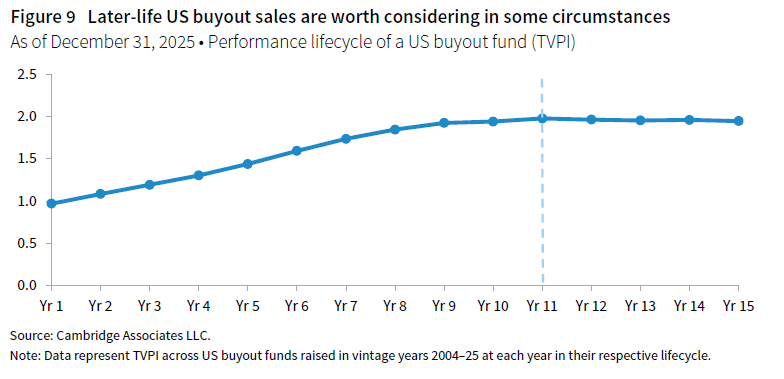
Secondary sales can also help potentially optimize outcomes by selling at favorable points in a fund’s performance cycle. Cambridge Associates data show that the median US buyout fund reaches its maximum TVPI in year 11 before plateauing or declining, which may make later-life sales worth considering in some circumstances (Figure 9). This underscores the normalization of secondary sales as a strategic portfolio management tool rather than a sign of distress.
LP interest sales: No longer niche, still nuanced
While LP interest sales have become more common, they remain complex transactions that require careful consideration of cost, timing, and relationship dynamics. A sale may not always be the optimal solution for every portfolio; the decision should consider the LP’s objectives, constraints, prevailing market dynamics, and overall portfolio positioning at the time of the contemplated transaction.
The choice of intermediary can materially affect pricing, transaction costs, and execution quality. Success in this specialized market often hinges on nuanced market knowledge, experience, and deep industry relationships. LPs should also recognize that a sale process can require meaningful internal time and resources, making advisor selection a critical factor to success.
Broader set of LP interest sellers
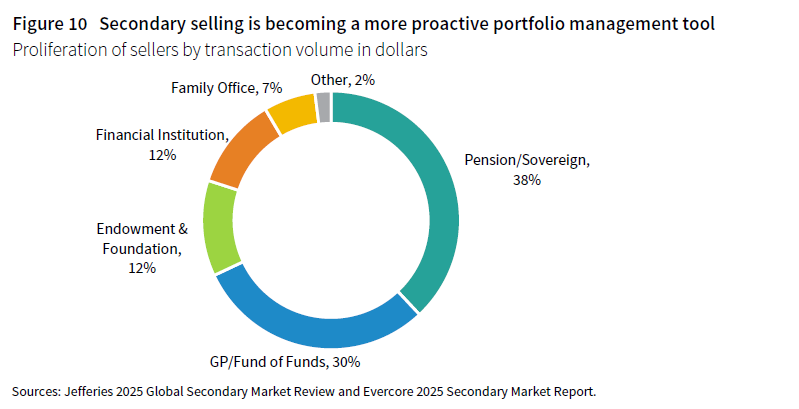
Pension funds have historically dominated the LP-interest seller universe, but the seller base has broadened to include a more diverse set of institutional LPs. In recent years, roughly half of selling LPs have been first-time sellers, while repeat programmatic sellers have also increased. Together, these patterns suggest that secondary selling is becoming a more accepted and proactive portfolio management tool (Figure 10).
CV elections: Balancing liquidity, value & alignment
As discussed, GP-led continuation vehicles require LPs to make consequential roll-or-sell decisions within a limited timeframe. Selling can crystallize gains and support rebalancing, while rolling can preserve exposure to a high-conviction GP and the potential for future value creation.
LPs should also consider the possibility of misalignment. GPs may pursue continuation vehicles to crystallize carried interest, extend management fees, or retain control over prized assets—potentially creating misalignment with LP interests. To mitigate these risks, ILPA guidance on GP-led secondary transactions provides a valuable framework, recommending that LPs prioritize transparent disclosures, seek independent validation (such as fairness opinions), and ensure robust LPAC engagement. By applying a disciplined and conflict-aware approach, LPs can leverage continuation vehicles both for liquidity management and for longer-term portfolio optimization.
Given the complexity and strategic importance of secondaries—whether used for liquidity generation or portfolio optimization—LPs should approach the market with informed judgment. The following section outlines guiding principles to help investors navigate the evolving secondary landscape and maximize long-term portfolio value.
Navigating the secondary market: Guiding principles
To navigate this evolving market successfully, LPs should keep several principles in mind.
Strategic flexibility through consistent allocations. Exposure to secondaries—including both LP- and GP-led transactions—can give LPs flexibility to respond to dislocations, capitalize on opportunities, and manage risk. The key is consistency. Although investors may be tempted to raise or reduce exposure in response to market conditions, attempting to time the market can result in missed opportunities and reduce the compounding benefits of sustained exposure. As our portfolio analysis suggests, a disciplined, ongoing allocation can support more efficient capital deployment, higher distributions, and stronger long-term portfolio outcomes across market cycles.
“Don’t try this at home”. A sustainable buy-side approach to secondaries generally requires dedicated pools of capital, specialized investment professionals, and the ability to consistently deploy capital across a range of transactions. Most investors are not structured to pursue LP- or GP-led transactions independently at scale. Attempting to do so without the necessary infrastructure can lead to weaker pricing, poorer execution, suboptimal portfolio outcomes, and potential strain on GP relationships. For most institutional investors, committing to experienced secondary fund managers is not only the most practical path, but also the most effective means of capturing the full range of benefits that secondaries have to offer.
Choose your partners wisely. The secondary market includes a broad and increasingly diverse set of buyers pursuing different strategies. LPs should understand the risks embedded in the approach of a specific manager and assess whether historical returns have appropriately compensated for those risks. Beyond performance, LPs should carefully assess a secondary buyer’s ability to originate, underwrite, and execute target transactions, as well as the stability and depth of their organization and investment team. Considering how various secondary strategies align with broader portfolio objectives and risk tolerance—and how different strategies may complement one another—can further enhance diversification and long-term resilience.
Conclusion: Secondaries can help navigate complexity while capturing opportunity
The evolution of the secondary market has expanded what institutional investors can do within private investment portfolios. Secondaries can support portfolio resilience, improve liquidity, accelerate capital redeployment, and help investors adapt to changing market conditions.
The broader implication is that LPs should look beyond individual transactions and treat secondaries as a permanent element of portfolio construction and management. Doing so requires consistent allocations, informed decision making, strong partner selection, and a willingness to refine the approach as the market evolves.
In a private markets environment defined by complexity and change, secondaries offer institutional investors a distinctive combination of flexibility, stability, and long-term value. With disciplined allocations, careful manager selection, and a long-term perspective, LPs can use secondaries as an enduring component of their PI portfolios.
Rohan Dutt - Rohan Dutt is Co-Head of Global Secondaries and a Managing Director at Cambridge Associates.
About Cambridge Associates
Cambridge Associates is a global investment firm with 50+ years of institutional investing experience. The firm aims to help pension plans, endowments & foundations, healthcare systems, and private clients achieve their investment goals and maximize their impact on the world. Cambridge Associates delivers a range of services, including outsourced CIO, non-discretionary portfolio management, staff extension and alternative asset class mandates. Contact us today.