
Details Matter: Endowment Spending Policy Is Only Part of the Story


The impact of endowment spending goes beyond the annual budget; spending practices are key inputs to the long-term investment strategy because they affect the investment portfolio’s risk tolerance and liquidity needs. Investment committees are often involved in setting the endowment spending policy, but the actual demands placed on the portfolio depend on more than the policy itself. Drawing on results of a CA Institute survey of endowment clients, this note explores how spending policies are established and implemented, while also highlighting several operational and governance details that can materially affect portfolio management and oversight.
Detail 1: Who determines the annual draw?
Our survey of endowments reveals that for nearly 50% of respondents, the investment committee (IC) is involved in establishing endowment spending policy, either exclusively or jointly with the finance committee. In practice, when the institution determines the annual amount drawn from the endowment, the IC controls the decision at 10% of institutions and shares the responsibility with the finance committee at 20% of institutions.
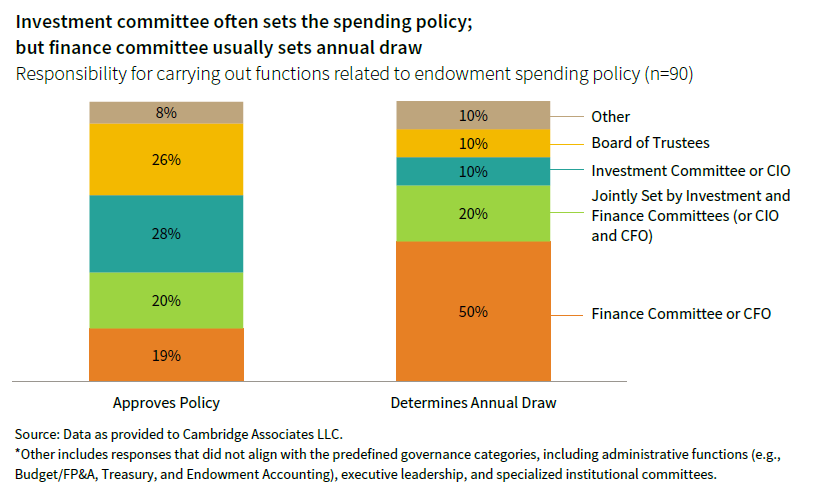
This is a notable governance disconnect between the group responsible for investment policy and those setting annual spending. The dynamic requires strong communication between investments, finance, and institutional leadership, including the Board of Trustees, to avoid surprises that could upend the long-term financial health of the institution. Communication and consultation are especially important in this era of non-profit management, when many organizations are weathering financial strains that come from research funding cuts, under-enrollment, and rising costs of doing business.
Detail 2: Does spending policy apply to all assets in the investment portfolio?
For nearly one-third of respondents, some assets in the long-term investment portfolio (LTIP) do not follow the endowment spending policy. This means they could be spent at a higher or lesser rate than the spending policy and could involve lumpier withdrawals. For example, if capital reserves are invested alongside the endowment, they may not be spent for four years, but in year five, 25% of the reserves may be withdrawn to fund a project. Over the course of the five-year period, the reserves averaged a 5% spend, but a withdrawal rate of 25% requires a different level of liquidity than a steady 5% spend. It is important to understand spending intentions and perhaps institute some gating policy on assets invested with the endowment to limit liquidity demands that may upend the long-term strategy.
Detail 3: What is the timing of the draw?
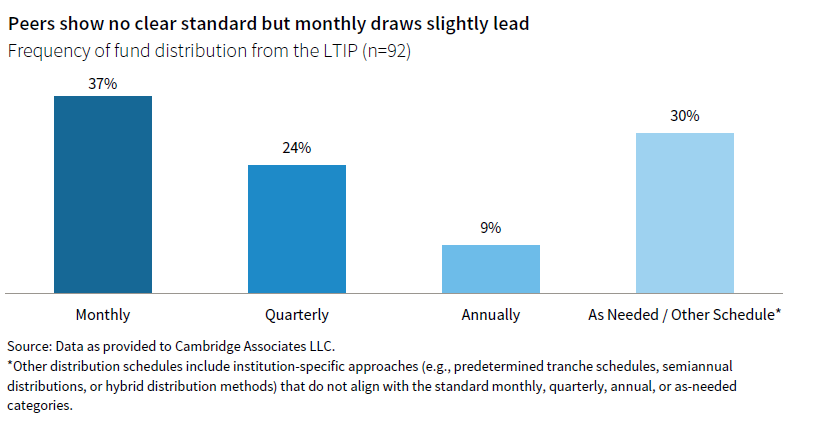
The majority of respondents spread the draw throughout the year: 37% distribute monthly and 24% distribute quarterly. The remaining organizations have one withdrawal (9%) or draw as needed/use another cadence (30%). There is no right or wrong answer about the timing of the draw. It is most important to understand the spending expectations so investment strategy is aligned with liquidity needs.
The spending details matter
Details about annual spending and endowment dependence provide helpful context for an investment committee charged with policy decisions and oversight of the endowment. The CA Institute researches these details with our clients periodically to hone our collective understanding of spending policies and spending practices. The nuances of spending implementation highlight the importance of strong communication between the various stakeholders who are involved in institutional leadership, finance, and investments. Staff, trustees, and investment committee members should understand not only the formal spending policy, but also how it is applied in practice.
Key questions for the investment committee to consider are:
- Does the institution draw funds annually in a single tranche, or more frequently throughout the year?
- Are market values smoothed in the spending calculation?
- Is there a lag between the valuation date and when the institution relies on the spending amount?
- Have donor expectations been clearly communicated, particularly when newly received gifts are phased into spending over time?
Understanding these details matters as they can influence portfolio liquidity needs, risk tolerance, and the funding delivered to support the endowment’s mission.
Billy Prout, Geoff Bollier, and Raul Najera Bahena also contributed to this publication.
Tracy Filosa - Tracy is a Managing Director and Head of CA Institute.
About Cambridge Associates
Cambridge Associates is a global investment firm with 50+ years of institutional investing experience. The firm aims to help pension plans, endowments & foundations, healthcare systems, and private clients achieve their investment goals and maximize their impact on the world. Cambridge Associates delivers a range of services, including outsourced CIO, non-discretionary portfolio management, staff extension and alternative asset class mandates. Contact us today.